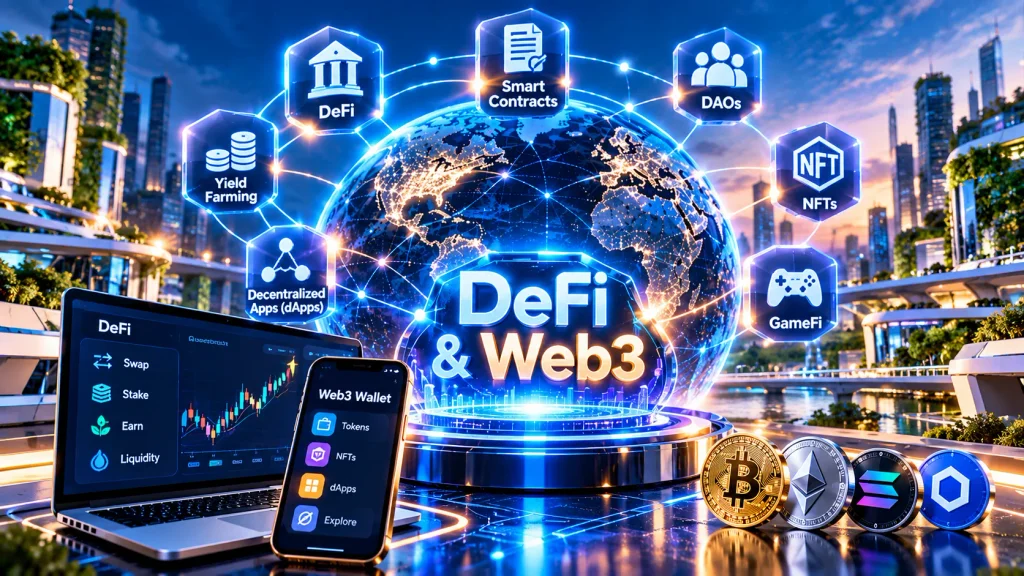
DeFi and Web3 are two important areas of the blockchain ecosystem. They introduce new approaches to financial services, digital ownership, applications, and online interactions. Learn how DeFi and Web3 work, why they matter, and the technologies behind this evolving digital ecosystem.
What Is DeFi ?
Decentralized finance, commonly known as DeFi, refers to financial applications and services built using blockchain technology and smart contracts.
Traditional financial services generally rely on banks, brokers, and other centralized intermediaries. DeFi aims to provide financial functions through decentralized networks and programmable blockchain applications.
DeFi can include services related to lending, borrowing, trading, payments, and digital assets.
How DeFi Works
DeFi applications operate through blockchain networks and smart contracts.
Instead of relying on a traditional institution to process every transaction, smart contracts can execute predefined rules automatically when their conditions are met.
Users typically interact with DeFi applications through cryptocurrency wallets.
Key concepts include:
- Smart contracts
- Decentralized exchanges
- Lending and borrowing
- Liquidity
- Digital assets
- Cryptocurrency wallets
- Blockchain networks
Decentralized Exchanges
A decentralized exchange, often called a DEX, allows users to trade digital assets through blockchain-based protocols.
Unlike a traditional centralized exchange, a DEX can allow users to interact directly with smart contracts rather than depositing assets into a centralized trading platform.
Different DEX designs use different mechanisms for matching trades and providing liquidity.
DeFi Lending and Borrowing
DeFi protocols can provide decentralized lending and borrowing services.
Users may supply digital assets to a protocol and potentially receive returns based on the rules of that protocol. Other users may borrow assets by providing required collateral.
The terms and risks vary between different protocols, and users should understand how a particular system works before interacting with it.
What Is Web3 ?
Web3 is a broad term commonly used to describe an evolving vision of the internet that incorporates blockchain technology, digital assets, decentralized applications, and user-controlled digital ownership.
Unlike traditional web services that often rely heavily on centralized platforms, Web3 applications can use decentralized networks and blockchain-based systems.
The exact definition of Web3 can vary, but blockchain technology and digital ownership are commonly associated with the concept.
Web3 and Decentralized Applications
Web3 applications, often called dApps, can use smart contracts and blockchain networks to provide services to users.
These applications may include:
- Financial applications
- Digital marketplaces
- Gaming applications
- Digital identity systems
- Social applications
- Digital asset platforms
The design and level of decentralization can differ significantly between individual applications.
Digital Ownership
One of the concepts associated with Web3 is the ability to represent digital assets and ownership using blockchain technology.
Tokens can represent different types of digital or real-world interests, depending on how they are designed and used.
NFTs are one example of blockchain-based tokens that can represent ownership or other rights associated with digital items.
DeFi vs Traditional Finance
| DeFi | Traditional Finance |
|---|---|
| Blockchain-based | Usually institution-based |
| Uses smart contracts | Uses traditional financial systems |
| Wallet-based interaction | Usually account-based |
| Can operate globally | Often organized through national systems |
| Transactions recorded on blockchain | Uses centralized financial records |
The two systems have different structures, but they can also coexist as blockchain technology develops.
DeFi & Web3 Risks
DeFi and Web3 technologies introduce new possibilities, but they also involve significant risks.
Users may face risks including:
- Smart contract vulnerabilities
- Loss of private keys
- Cryptocurrency price volatility
- Fraud and scams
- Protocol failures
- Liquidity risks
- Regulatory uncertainty
Understanding the technology and checking the risks of a specific application are important before using DeFi or Web3 services.
The Future of DeFi & Web3
DeFi and Web3 continue to develop as developers experiment with decentralized applications, blockchain infrastructure, digital assets, and new forms of online interaction.
The ecosystem is still evolving, and different projects use different approaches to decentralization, governance, security, and user ownership.
For beginners, understanding the underlying technologies is a useful first step before exploring individual applications and digital assets.
DeFi & Web3 Topics on BlockOrbis
1. Blockchain Explained
Understand the blockchain technology that supports decentralized applications, digital assets, and Web3.
2. Crypto Security
Learn practical ways to protect your wallets, digital assets, accounts, and personal information.
3. Altcoins & Digital Assets
Explore digital assets, tokens, and developments across the broader cryptocurrency ecosystem.